Showing posts with label Facebook. Show all posts

Tuesday, September 29, 2015

CASA Marketing (Facebook Ads)

As I have learned this week, Facebook Ads are an ideal resource to utilize in order to increase reach towards an intended target audience. The two main types of Facebook Ads are those that appear directly in a news feed or the kind that are placed on the right side of a web page. For the purposes of social media marketing, Facebook Ads that appear on the right side of a web page are typically the most common. Once you pay for a Facebook advertising campaign, it will begin to appear in news feeds, especially those who find interest in the subject manner that you are promoting.

The ultimate goal of advertising on Facebook is to entice individuals to click on your ad, in hopes that they will like your page in the process. Once you begin regularly posting about your website or blog via Facebook, in addition to running an ad, you can further promote content by "boosting" it, that is, paying an additional fee to Facebook to increase the online presence of your posts.

Curious what a promoted post looks like on Facebook? Fear not, I have you covered with this screenshot pictured below:
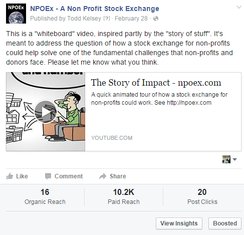


Notice that once a post is boosted, Facebook provides in depth information that you would be otherwise unable to view, which includes data related to organic reach, paid reach, and post clicks.

In the event that you're ready to create a Facebook ad, I recommend following a few of the following pointers to guide you through the process:

  • Monitor how many clicks your page/content receives, especially the click through rate (CTR) 
  • Make sure to target a specific target market that would be interested in the content that you're promoting 
  • Be sure to add interests to your Facebook advertising campaign to hone in on a particular audience 
  • Decide whether you want to run an ad on a Lifetime Budget or Daily Budget, and add corresponding start/end dates if necessary
  • Understand the concept of CPC (cost per click)
  • Add images to enhance content
  • Keep content simple and offer a value proposition to differentiate your brand from others 
  • Consistently monitor the ad campaign to track progress and results 

Monday, September 28, 2015

Facebook Ad

This past weekend, I created a Facebook Ad that is linked to this exact blog. The ultimate goal of creating an advertisement on Facebook is to send people to a specific website. In this case, that website is my personal marketing blog.

I specified social media marketing as an interest while developing my Facebook Ad in order to ensure that I was reaching out to the correct target audience. With a clearly defined target market, it is easier to reach certain segments within the Facebook community. 

I also made sure to create a Lifetime Budget of $20.00, which is planned to run for approximately a week. After the advertisement runs its full course, I will have a much better understanding of how Facebook advertising can benefit a company in terms of overall ROI. 

After beginning my Facebook Ad on 9/25, I have noticed results starting to compile. The following images represent various results I found interesting from the early parts of my Facebook campaign:


Although my Facebook advertising campaign is still in its initial stages, some insightful data is available to analyze, which includes:
  • I have 12 website clicks as of 9/28
  • Males and Females between the ages of 18-24 appear to represent my largest reach in terms of demographics
  • My link has only been clicked on by people in one country, which is the United States 
  • My ad campaign has resulted in 4,214 impressions as of 9/28
  • As of 9/28, my Facebook Ad has an overall reach of 2,359 people
  • CPM as of 9/28 = $2.47
Below is a glimpse into the results of my completed Facebook Ad campaign, after it ran its course for a full week:


Thursday, September 24, 2015

Facebook Activity

Today in class, I liked the following two pages on Facebook: http://www.facebook.com/npoex and
http://www.facebook.com/freedomsongs.

After doing so, I was granted administrative access to each Facebook page to in order to determine if a return on investment was being made. To measure this, I navigated through each page's activity and insights tabs to decipher if boosting posts resulted in a larger overall reach for the intended target audience. Once I completed the class activity, it became clear that boosted posts clearly reach more people on Facebook than do organic posts.

The NPOEx Facebook page had quite a few posts boosted. In comparison to organic posts, it was rather evident that boosted posts reached more people. Typically, this resulted in more post clicks for the page, which is the ultimate goal when investing in advertising on Facebook.

The Freedom Songs page did not appear to contain many boosted posts. However, the page was useful to analyze information pertaining to what type of people view the page, including what countries they reside from.

Here are some notes from what I discovered on the Freedom Songs Facebook page, which focused on user information:

  • Top 3 Countries 
    • Egypt
    • Bahrain
    • Yemen
  • Gender/Ages
    • Men- 53%
    • Women- 46%
    • Most popular age group: 18-24
      • 26% Men
      • 24% Women
Although the United States was not the primary country that dominated likes for the Freedom Songs page, I found it interesting that English was still the most popular language.

Overall, this exercise was very rewarding, as I now have a better understanding of how to navigate through Facebook pages as an administrator in order to determine if advertising efforts are resulting in a ROI.

For an inside look at the one of Facebook pages I have discussed within this blog post, please look at the screenshot pictured below:


Tuesday, September 22, 2015

CASA Marketing (Facebook Pages)

Believe it or not, creating a Facebook page is one of the easiest options to begin a social media marketing campaign. However, before creating a page of Facebook, it is important to understand the company's business model, In short, Facebook earns a majority of its revenue off of advertising. More specifically, Facebook charges people to "boost" posts on its pages to promote them across more news feeds. Therefore, if you create a Facebook page and solely attempt to gain an online presence through current friends or colleagues by earning "likes", your page will be limited to only those people you are connected with on the site. On the other hand, if you pay Facebook to "boost" your page, it will gain exposure and will become exposed to people across the world through Facebook's sponsored advertising.

In order to determine if it is worth "boosting" your page on Facebook, it is necessary to look at various analytics. For example, if you publish a post, Facebook will allow you to track the number of page views associated with that specific page. By analyzing page views and traffic, you will be able to determine if a Facebook page is earning a large enough return on investment (ROI) to warrant paying reoccurring advertising fees. One way to determine if a Facebook page is worth "boosting" is to pay a nominal rate to gauge its level of success. If popular, it may be logical to expand advertising efforts to increase social credibility and grow your overall brand. If unsuccessful, it may be time to reconsider advertising on Facebook. Instead, focusing on search engine optimization (SEO) on Google could be an sound alternative in order to effectively advertise a brand.

Overall, I highly recommend creating a Facebook page for your company or brand if you have not done so already. In addition, it is worth the minimal investment to "boost" your posts to appeal to a larger target audience. Focusing on content as opposed to the channel of social media (Facebook for this example) is also important to consider, especially where social media marketing strategy is concerned.

Speaking of Facebook pages, feel free to take a look at the screenshot pictured below of a page I made for a company I created my junior year in college, which is called Tuned Vision.